



Key Highlights
Did you know? Europe continues to be one of the most significant trading hubs in the world, providing a vast array of high-quality products to international markets. European imports are renowned for their quality, inventiveness, and dependability in everything from luxury fashion and speciality delicacies to sophisticated machinery and automobiles.
These products are essential to businesses and customers in a variety of industries, including manufacturing, healthcare, technology, and lifestyle. Gaining knowledge of Europe's top imports and the major importers that control this commerce will help you understand market trends and international supply chains. In this blog, we will explore the Major imports from Europe, the Europe importers list, the top Europe importers, and the Europe import data.
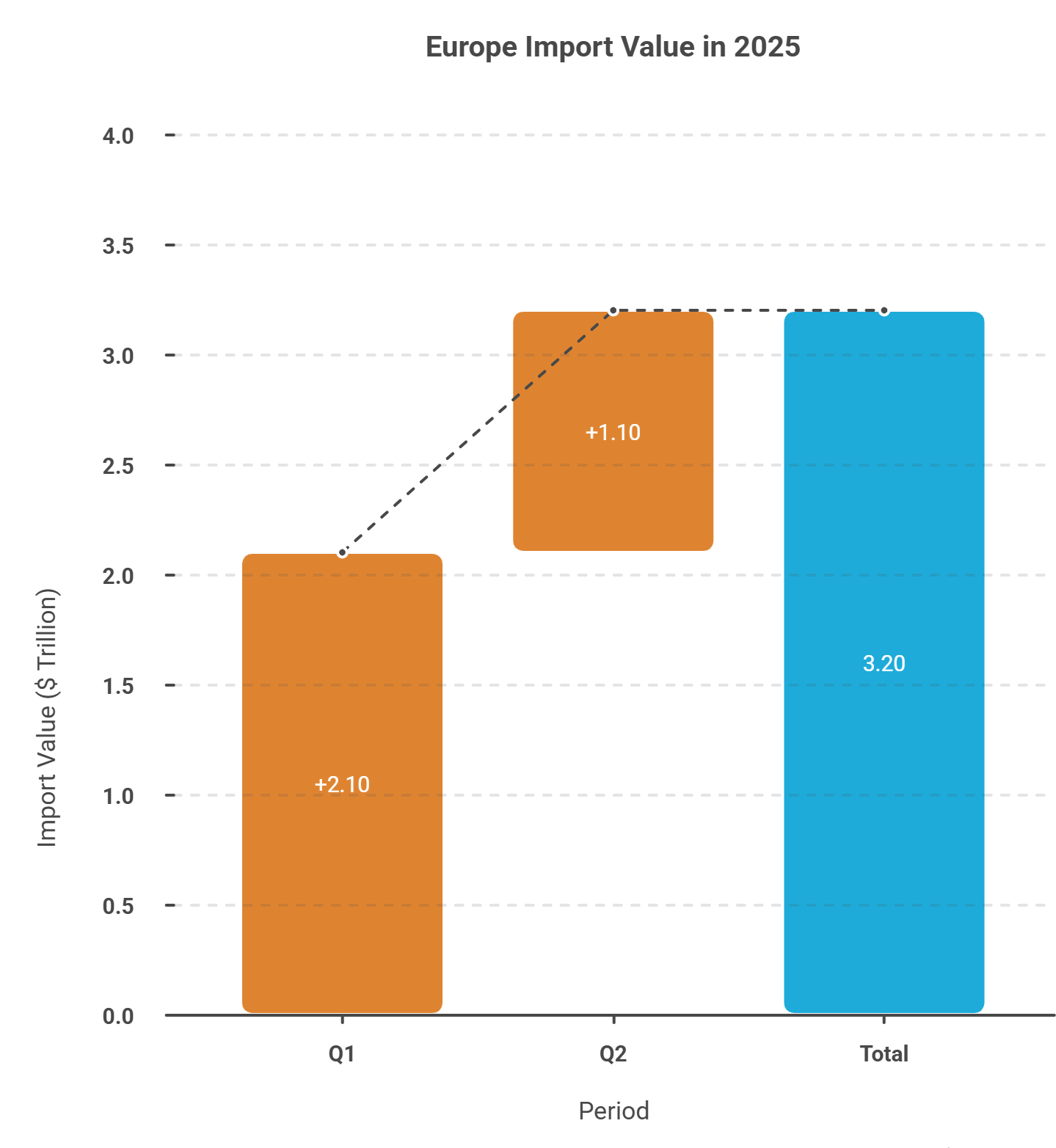
In the first half of 2025, Europe's total import value was approximately $3.2 trillion, with Q1 imports totalling $2.1 trillion and Q2 imports dropping to $1.1 trillion.
Additional comprehensive data for 2025 reveals that in May 2025, the European Union's (EU) goods trade balance was €13.1 billion, while imports totalled €203.8 billion.
| Trend/Sector | Details | Time Period / Key Products |
| Overall Imports | Decreased by 7.1% | Q2 2025 |
| Energy Sector | Significant increase in LNG imports, but a decline in petroleum oil imports. | N/A (General trend) |
| Agri-Food Trade | Imports worth €48.1 billion | Q1 2025 (Primarily driven by higher prices for cocoa, coffee, fruit, and nuts) |
According to Europe import data, the European Union's (EU) imports from outside the bloc reached €1.48 trillion in the first seven months of 2025. This represents a 5.3% increase over the same time frame in 2024.

| Time Period | Europe Import Data |
| Quarter 1 (Q1) 2025 | $2.1 trillion |
| Quarter 2 (Q2) 2025 | N/A |
| May-25 | €203.8 billion |
Based on the Europe import data, the import trends for the EU in 2025 paint a contradictory image. The trade surplus decreased after a robust first quarter with $2.1 trillion in imports, followed by a 7.1% drop in the second quarter. Although certain industries, such as agri-food and LNG, saw growth in the first half of the year, the total value of imports in May also decreased by 2% from the year before.
Now, it’s time to explore the list of Major imports from Europe.
Below is the list of importing goods from Europe:
| Top Rank | Major imports from Europe | Europe import data (in billions of dollars) |
| 1 | Mineral fuels, oils, and distillation products | 504.85 |
| 2 | Electrical and electronic equipment | 363.49 |
| 3 | Machinery, nuclear reactors, and boilers | 302.92 |
| 4 | Vehicles other than railway, tramway | 146.74 |
| 5 | Pharmaceutical products | 112.7 |
| 6 | Organic chemicals | 104.28 |
| 7 | Optical, photo, technical, and medical apparatus | 97.16 |
| 8 | Plastics | 65.1 |
| 9 | Articles of apparel, knit or crocheted | 48.02 |
| 10 | Pearls, precious stones, metals, coins | 45.16 |
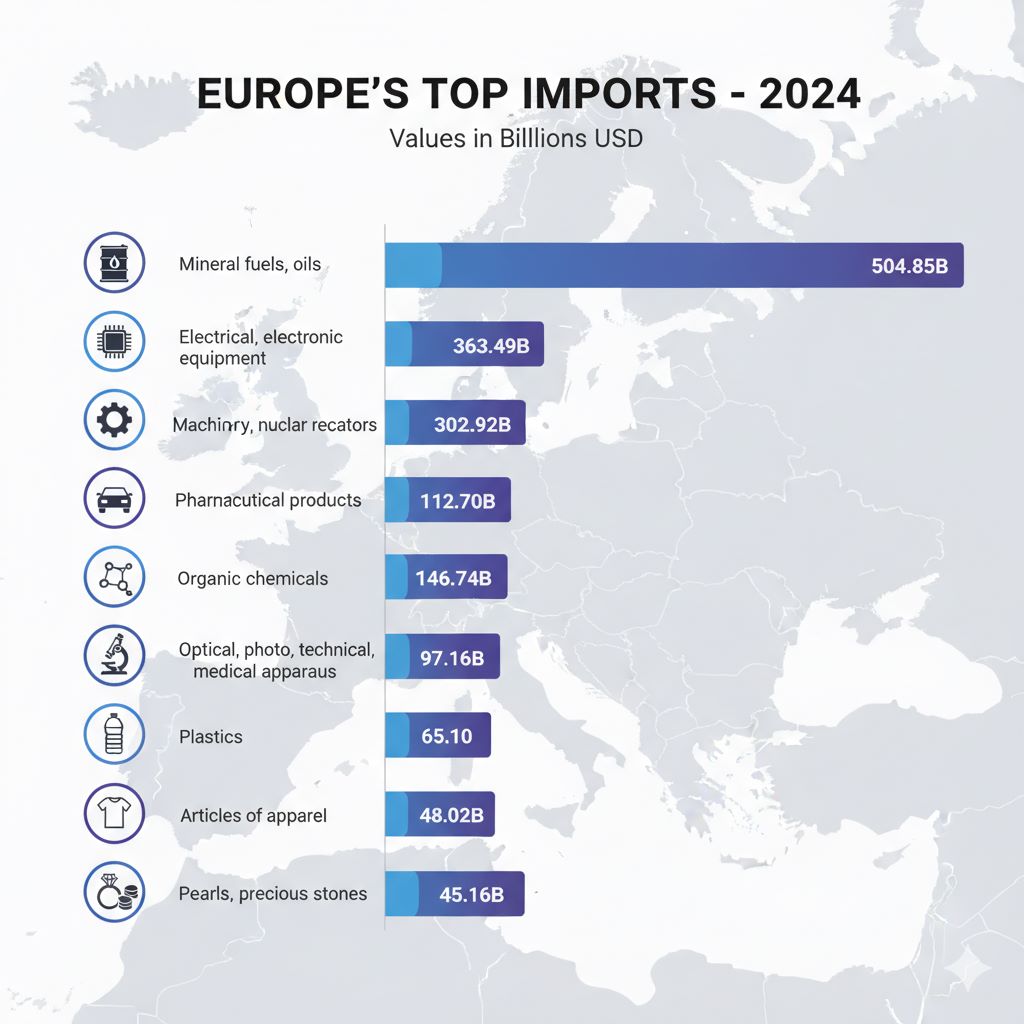
The following provides a detailed explanation of each of the top Major imports from Europe:
Mineral fuels and oils are the largest import category because they are the foundation of Europe's energy needs. To power homes, businesses, and transportation, nations like the Middle East, Norway, and Russia supply crude oil, natural gas, and refined petroleum products.
These imports are essential to preserving energy security and fostering the industrial development of Europe. For economic stability, reliance on mineral fuels is still important despite initiatives to use renewable energy.
According to Europe import data, Europe imports a wide variety of electrical and electronic equipment, such as power machinery, consumer electronics, semiconductors, and communication devices. These imports propel technological development in industries like smart infrastructure, healthcare, and automobiles.
The economies of Asia, the United States, and China are important suppliers, guaranteeing a constant supply of high-performance parts and innovation. This market is further boosted by the growing demand for smart devices and renewable energy systems.
Europe's manufacturing and energy sectors depend heavily on sophisticated machinery and industrial equipment. Turbines, industrial boilers, and nuclear reactor components that power large-scale manufacturing and energy generation are examples of imports.
In this sector, major exporters include the United States, Japan, and South Korea. These goods are essential for raising industrial productivity and assisting Europe in its shift to cutting-edge manufacturing technologies.
To satisfy the needs of its varied markets, Europe imports a broad range of automobiles, including trucks, passenger cars, and speciality cars.
Even though Europe produces a lot of cars, imports fill supply shortages and bring in new models. The US, South Korea, and Japan are important suppliers. This import category has become even more diversified as a result of the growing popularity of electric vehicles (EVs).
For Europe's healthcare system to have access to cutting-edge medications, vaccines, and medical supplies, pharmaceutical imports are essential. The needs of patients, pharmacies, and hospitals throughout the continent are met in part by these imports.
The top exporters of premium pharmaceutical products to Europe are the United States, Switzerland, and India. The growing demand for speciality and biotech medications keeps driving this market's expansion.

Now, explore the top importers in Europe or the Europe importers list with import values, trading partners, and top commodities
| Top Importers in Europe | Europe import data | Key Import Categories | Major Trading Partners |
| Germany | ~$1.91 trillion | Industrial machinery, vehicles and parts, electronics, pharmaceuticals, and mineral fuels. | The Netherlands, China, France, and the United States. |
| United Kingdom | $1.11 trillion | Vehicles, machinery, mineral fuels, and precious metals. | Germany, China, the United States, and the Netherlands. |
| France | $1.05 trillion | Aircraft, pharmaceuticals, vehicles, and consumer goods. | Germany, Italy, China, and Belgium. |
| Netherlands | $825 billion | Mineral fuels, electrical equipment, machinery, and pharmaceuticals. | Germany, Belgium, China, and the United States. |
| Italy | $760 billion | Energy products, industrial equipment, and intermediate goods for its manufacturing and automotive industries. | Germany, France, and China. |
| Belgium | Over $519 billion | Chemicals, pharmaceuticals, and machinery. It also serves as a key trade hub. | Germany and the Netherlands. |
| Spain | Over $451 billion | Diverse goods support its economy, including strong sectors like tourism. | The European Union. |
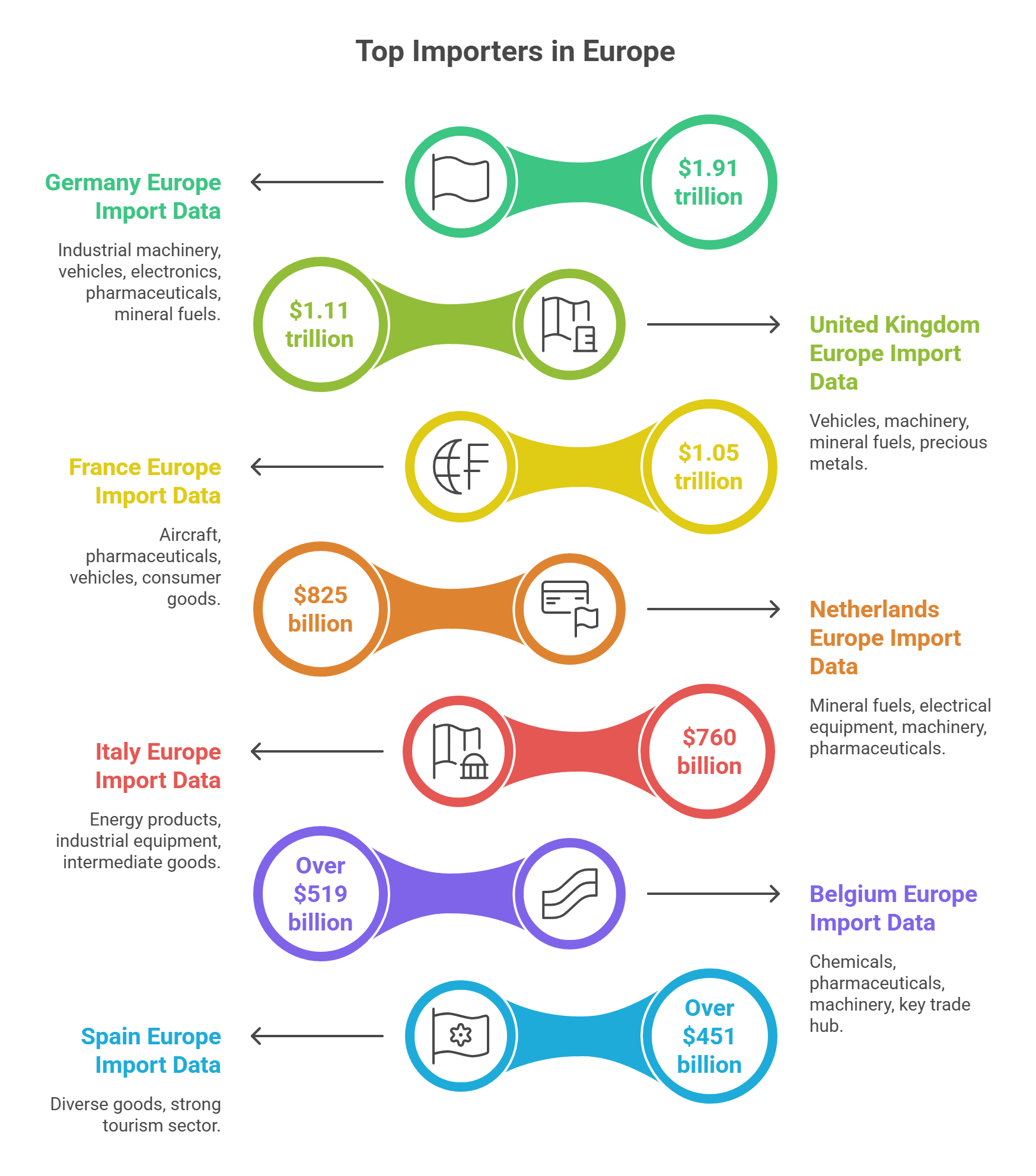
Based on total import value, the European Union's major economies Germany, the United Kingdom, France, the Netherlands, and Italy are the biggest importers in Europe. These nations are the backbone of the European market and are the top importers of a wide range of products, such as machinery, vehicles, electrical equipment, and mineral fuels. To know the exact insights on Major imports from Europe, the list of importers in Europe, the Europe import data and other key details.
Here are the major trading partners of Europe
| Destination Country | Share of EU Exports | Year |
| US | 20.60% | 2024 |
| UK | 13.20% | 2024 |
| China | 8.30% | 2024 |
| Switzerland | 7% | 2023 |
| Turkey | 4% | 2023 |
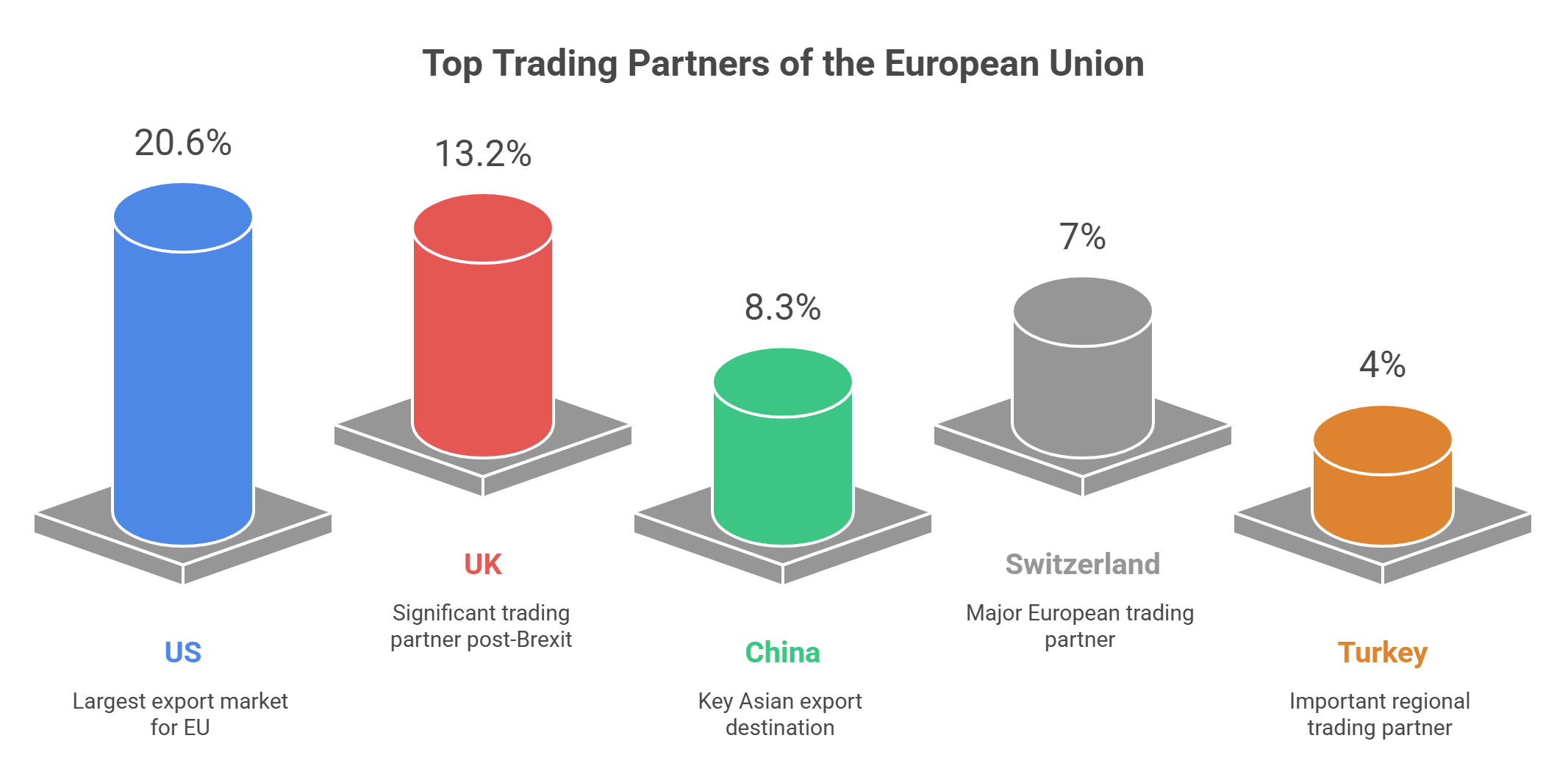
The leading exporter of manufactured products and services worldwide is Europe. With a 20.6% share of all EU exports in 2024, the US was the biggest destination, followed by the UK (13.2%) and China (8.3%). Switzerland (7%) and Turkey (4%) were other significant trading partners for products in 2023.
In terms of service trade, the US was the EU's top trading partner in 2023, followed by the UK and Switzerland.
If you would like the most up-to-date and accurate information on Major imports from Europe or Europe imports by country, please visit Seair Exim Solutions to get Europe import data and a list of Europe's top imports.
Additionally, if you want the latest information on Europe exports by country, Europe's top 10 imports, trade partners, trade data, imports from Europe, and a supplier list, you should start by looking through our export import data bank.
Seair Exim Solutions is among the top data-driven tools for analysing shipments from overseas. By providing a database of more than 130 countries, we make it simple for you to access information about international trade as well as Indian export and import data.

Due to the continent's reputation for high standards, innovative technology, and a wide range of product offerings, the import market from Europe is still thriving. To stay ahead in a competitive market, companies can strategically plan their sourcing and investment decisions by identifying the top imports and leading importers. Europe's exports continue to play a significant role in international trade, whether they are luxury goods, machinery, cars, or pharmaceuticals.
Moreover, if you still need any kind of assistance regarding Europe's trade partners list, the list of importers in Europe, or major imports from Europe statistics and Europe import data. Visit our platform today and schedule a free live demo hassle-free.
Q1. Which Products Does India Export the Most to Europe?
India’s major exports to the European Union are a mix of industrial goods, chemicals, and pharmaceuticals. The top products include:
These categories highlight India’s strength in manufacturing, chemicals, and pharmaceutical industries.
Q2. Which Products Does India Import the Most from Europe?
India mainly imports advanced manufactured goods and high-tech products from Europe. The key import categories are:
Europe serves as a hub for advanced technology and innovation, making these imports vital for India’s industrial, medical, and scientific sectors.
Q3. What are the Major Exports of Europe?
Europe’s export profile is dominated by high-value manufactured and specialized goods, reflecting its industrial strength. The major exports are:
These exports underline Europe’s role as a global leader in automotive, healthcare, machinery, and technology sectors.
Q4. Who are the Top 10 Biggest Importers in the World?
According to global trade data, the top 10 biggest importers are:
These countries dominate global trade, accounting for the bulk of world imports across sectors like machinery, fuels, electronics, and consumer goods.
Q5. Who is the Largest Importer in Europe?
The largest importer in Europe is Germany, with imports worth approximately $1.91 trillion.
Germany is followed by:
Germany’s strong industrial base and reliance on global supply chains make it the top importer in the region.


We have successfully served many reputable clients for Import-Export Data Information Services. Here are some of our clients:
Copyright © 2009 - 2026 www.seair.co.in. All Rights Reserved.





Leave a Comment